
Rice County Court Records After Arrest
After an arrest in Rice County, law enforcement takes the person through booking at the Rice County Jail when jail custody is needed. That booking record can list a charge as it was entered at intake, but the court record starts when a prosecutor files or pursues charges in Rice County District Court. The Rice County Attorney's prosecution page says the Criminal Division handles all felonies committed in Rice County, misdemeanor and gross misdemeanor offenses outside city limits, certain countywide misdemeanors and gross misdemeanors, and felony cases from the state correctional facility in the county.
The jail side and court side answer different questions. For the custody record, roster timing, and booking fields, use Rice County jail inmate records. For booking photos, use Rice County jail mugshots. Court records after a jail arrest focus on filed charges, first appearance events, warrants, bond terms, amended counts, dismissals, pleas, findings, and sentences. The arrest explains why the case may exist. The court file shows what the government charged and what happened next.
The court path also depends on charge level. The Rice County Attorney explains that misdemeanor cases usually proceed to arraignment, where rights are explained and a plea may be entered. Felony and gross misdemeanor matters use a First Appearance, Initial Appearance, or Rule 5 hearing. At that hearing, the defendant is advised of rights and charges and may seek a public defender, but no plea is taken.
Find Rice County Court Records
Most public criminal case lookup starts with Minnesota Court Records Online, usually called MCRO. The Minnesota Judicial Branch MCRO overview describes Case Search, Document Search, Register of Actions, and online public document access. In Rice County, MCRO is the main public index for filed criminal and traffic cases after an arrest has become a court matter. It is separate from the sheriff's roster, which lists current jail custody information.
The MCRO screen gives several ways to search. A name search can work for many older or completed cases, but MCRO warns that pending criminal, traffic, and petty misdemeanor cases without a conviction may not return in defendant-name search results. Pending cases can still return by case number. If the roster or warrant list shows a court case number, that number is often the most direct search path.
The MCRO case search screen is shown in the source image below.
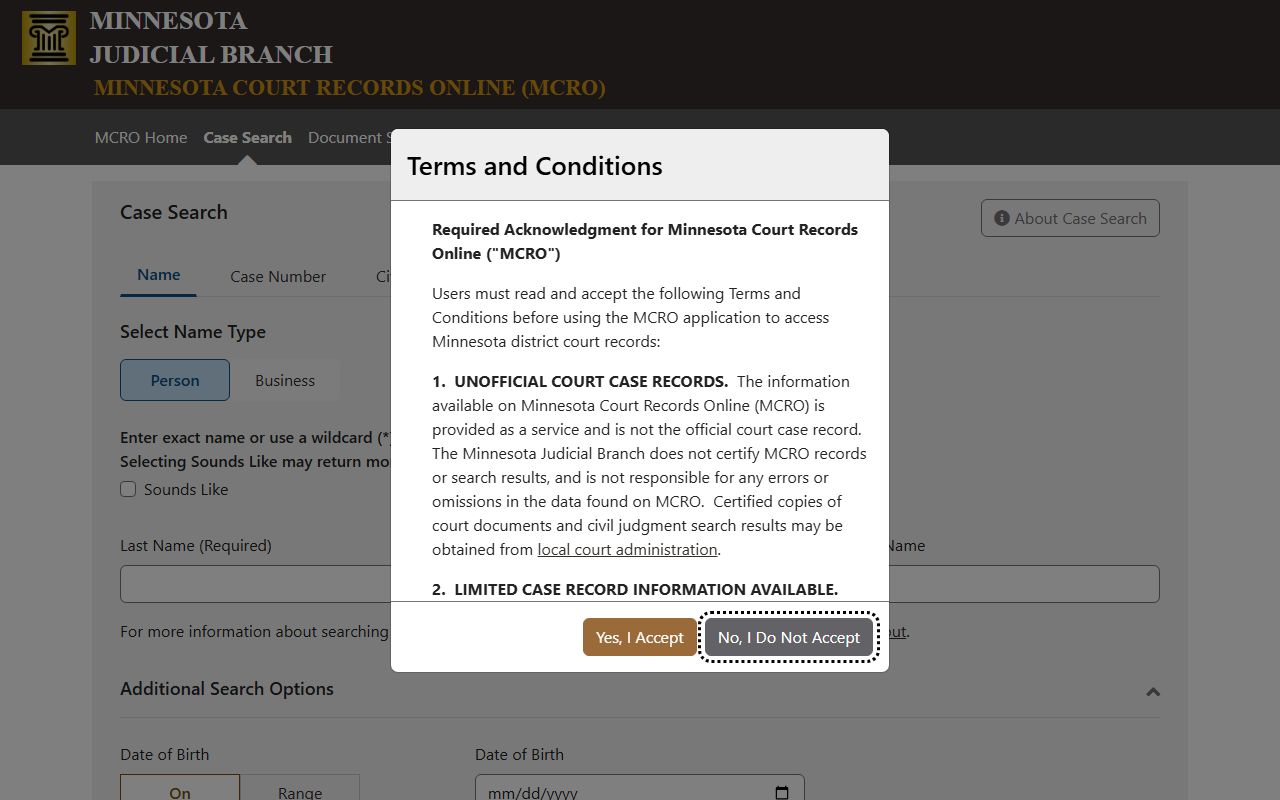
The search fields matter because a name-only search can miss a pending case that a case-number search will locate.
| MCRO Field | Type | Use for Rice County Records |
|---|---|---|
| Name, Case Number, Citation Number, Attorney | Search tabs | Choose the method that matches the information from the arrest, citation, roster, or warrant list. |
| Last Name and First Name | Person search | Use exact names when known. A trailing wildcard can be used after two characters. |
| Date of Birth | Date filter | Narrows common names when the public record allows the searcher to use that detail. |
| Date Filed | Date filter | Useful when the arrest date is known but the case number is not. |
| Case Category | Checkbox | Select Criminal for most post-arrest charge searches. |
| Case Status | Radio filter | Use All when unsure whether the case is active or inactive. |
| Court Locations | County selector | Select specific county court locations and choose Rice. |
Rice County Arrest Charge Path
The charge listed at booking is not always the charge filed in court. Rice County's prosecution page says law enforcement investigates crimes and sends evidence to the County Attorney for review. That evidence can include witness statements, drug tests, fingerprints, ballistic tests, or other case material. The County Attorney then decides whether charges are supported. The office does not investigate crimes or take crime reports, so a jail arrest record should not be read as the prosecutor's final charge decision.
For Rice County court records after a jail arrest, the charging document is the bridge from the law-enforcement file to the court file. It names the defendant, cites the alleged offense, and starts or supports a criminal case. Minnesota practice commonly uses a complaint in many criminal matters. The research did not locate Rice County-specific local rules that change those statewide basics, so the table below stays general and avoids promising a document type for every case.
| Charging Document | Who Uses It | What It Means in the Court Record |
|---|---|---|
| Complaint | Prosecutor, often based on law-enforcement investigation | A formal written charge that commonly starts a Minnesota criminal case after arrest or citation. |
| Information | Prosecutor | A prosecutor-filed charge document used in some criminal procedures after the case is in court. |
| Indictment | Grand jury process | A charge returned through grand jury procedure, most associated with very serious felony matters. |
The Rice County prosecution page is also a useful source because it identifies the local office that reviews felony and many misdemeanor charging decisions.
That local prosecution role is why the court charge may look different from the jail roster entry made at booking.
Rice County Charge Status
Charge status is the part of the court record that shows where a count stands. A case can begin with one charge, then add, amend, reduce, dismiss, or resolve counts as evidence, plea talks, motions, and court rulings develop. That is why a Rice County court record after an arrest should be read by count and event date, not just by the first charge line. The Register of Actions can show hearings and docket events, while the charge list shows each count's current posture.
| Status | Plain Meaning | Why It Matters |
|---|---|---|
| Pending | The charge is filed and not yet finally resolved. | A pending charge is an accusation, not a conviction. |
| Amended | The prosecutor or court record changed the count, level, or wording. | The current charge may differ from the jail roster charge. |
| Dismissed | The count was dropped by the court or prosecution. | The arrest can still have existed even when a count is dismissed. |
| Plea or Finding | The case reached a plea, verdict, or judicial finding. | This is where conviction analysis may begin, depending on the exact outcome. |
| Sentenced | The court imposed the penalty or terms after conviction. | Custody may shift from the Rice County Jail to the Minnesota Department of Corrections. |
Rice County Court Contact
MCRO is useful for public online searching, but it is not the official certified court record. The Minnesota Judicial Branch says certified copies must come from local court administration. For Rice County court records after an arrest, that office is Rice County District Court, part of Minnesota's Third Judicial District. The court has original jurisdiction over criminal, traffic, civil, family, probate, and juvenile cases filed in Rice County.
Rice County District Court
218 N.W. Third Street
Faribault, MN 55021
Phone: 507-497-7134
Business hours: Monday through Friday, 8 a.m.-4:30 p.m.
Searchers who need a certified disposition, a certified copy of a complaint, or help with a case-number mismatch should use court administration rather than relying on a screenshot or third-party index.
Warrants, Bond, and Holds
Rice County links an official active warrant PDF from county resources. The warrant record can include warrant number, type, defendant name, case number, citation number, offense date, issue date, current status, judge or issuing authority, and offense description. Confidential address and phone details are hidden. A warrant can lead to a jail arrest, and the later court record may show the hearing, bond, or appearance issue tied to that warrant.
Bond is separate from guilt. Rice County did not publish a dedicated bond instruction page in the source set, so current release details should be verified with the jail, court, or the live court file. Bond may be set at a first appearance or arraignment. A hold, detainer, warrant from another county, DOC matter, federal hold, or ICE detainer can block release even if local money bond is posted.
| Release Term | Meaning |
|---|---|
| Cash bond | Money posted as directed by the court or jail to secure appearance and comply with release terms. |
| Conditional release | Release with court-ordered rules, such as no contact, testing, reporting, or travel limits. |
| Personal recognizance | Release based on a promise to appear, without a cash payment. |
| No-bond hold | Payment alone will not cause release until the judge or holding authority changes the order. |
Charges vs Convictions
A Rice County arrest, a jail booking, and a filed charge do not prove guilt. A charge is the government's allegation. A conviction requires a guilty plea, verdict, or other qualifying finding in court. This distinction is vital when reading court records after a jail arrest because public records often show both the original accusation and the later outcome. Treat each count as its own line of history.
| Point of Comparison | Charge | Conviction |
|---|---|---|
| Stage | Accusation filed or pursued after arrest. | Resolved finding of guilt or qualifying plea. |
| Proof | Based on charging standard and court procedure. | Requires proof beyond a reasonable doubt or a valid plea. |
| Record meaning | Shows what was alleged. | Shows what was legally established. |
| Custody effect | May affect bond or release terms. | May lead to sentence, probation, jail, or DOC custody. |
Sealed vs Expunged Records
Minnesota record limits can affect what appears online. Minn. Stat. ch. 609A governs criminal expungement. Expungement is a court process that can seal qualifying records from public view. It does not mean every private copy, news copy, or third-party repost has been erased. It also does not turn a current public case into a secret case without a legal basis.
Sealed and expunged are often used as if they mean the same thing. In Minnesota, the practical question for a public lookup is whether the record is still visible to the public and which agencies may retain access under law. Juvenile matters, sealed cases, expunged records, active investigative data, and nonpublic detention data can be missing or limited online.
| Record Limit | Public View | Important Limit |
|---|---|---|
| Sealed | Hidden or restricted from ordinary public access. | Some courts or agencies may still access it when law allows. |
| Expunged | Removed from ordinary public court access after a qualifying order or process. | Does not automatically remove every noncourt copy already made elsewhere. |
| Active investigative data | May be withheld while the investigation is active. | The agency should identify the legal basis for denial or redaction. |
Note: MCRO also has online display limits, so absence from a name search is not the same as proof that no Rice County case exists.
Rice County Record Limits
Several Minnesota laws shape the public record boundary after a Rice County arrest. Minn. Stat. 13.03 makes government data public unless a law classifies it otherwise. Minn. Stat. 13.82 governs law-enforcement data, including arrest data and booking photographs. Minn. Stat. 13.85 covers corrections and detention data, including private or confidential jail information that could reveal medical, psychological, financial, safety, informant, or security-sensitive details.
The Rice County Data Practices policy says public-data requesters cannot be required to identify themselves or use a form, and there is no fee just to inspect public data. Copies can involve actual costs or the statutory paper-copy rate for small black-and-white copy requests. Nonpublic data requires proof of identity or authority, and a notarized form or consent may be needed.
Important: Public court access is for record review only. It cannot be used for employment, housing, credit, insurance, or any other FCRA-covered decision.